
If you’ve ever had orthodontic treatment in the past, you might remember biting into a tray filled with thick dental putty. Traditional impressions were once the standard for creating models of your teeth—but technology has changed.
Today, many orthodontic offices use digital scanning systems like iTero instead of traditional molds. One of the most talked-about claims is that iTero scans offer up to 99.7% accuracy. But what does that really mean?
Let’s break down the differences between iTero digital scans and traditional impressions, including accuracy, comfort, and overall treatment precision.
What Are Traditional Dental Impressions?
Traditional impressions involve placing a tray filled with soft, moldable material into your mouth. You bite down and hold still for several minutes while the material hardens around your teeth.
Once removed, the mold is used to create a plaster or digital model of your smile. That model then guides the creation of braces appliances, retainers, or clear aligners.
While this method has been used successfully for decades, it has a few common drawbacks:
- The material can feel bulky or uncomfortable
- Some patients experience gag reflex
- Movement during setting can distort results
- Bubbles or tears may reduce precision
- Retakes are sometimes necessary
Although effective, traditional impressions rely heavily on technique and patient cooperation during the setting process.
What Is an iTero Digital Scan?
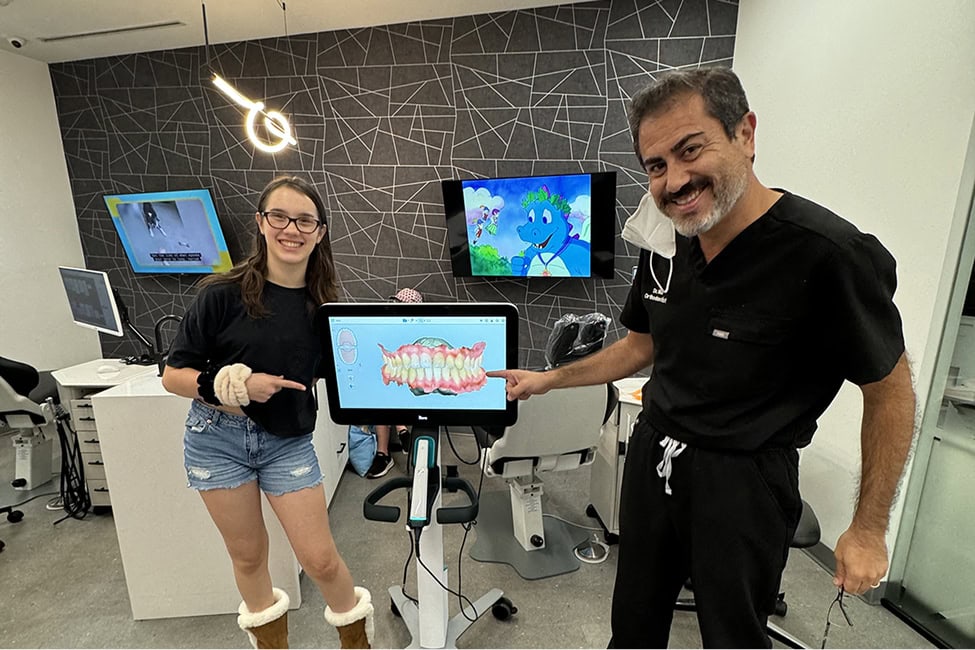
An iTero digital scan uses a small handheld wand to capture thousands of images of your teeth in minutes. These images are stitched together into a detailed 3D model of your mouth.
There’s no putty, no trays, and no waiting for material to harden. Instead, the scanner creates a real-time digital model that appears instantly on a screen.
This digital model can be used for:
- Invisalign treatment planning
- Braces appliance design
- Retainers
- Monitoring tooth movement
- Smile simulations
Because it’s digital, the file can also be sent directly to a lab without needing to ship physical molds.
What Does 99.7% Accuracy Mean?
The 99.7% accuracy claim refers to how closely a digital scan reflects the true shape and position of your teeth compared to traditional impression methods.
In practical terms, this level of precision means:
- Extremely detailed capture of tooth surfaces
- Precise measurement of spacing and alignment
- Accurate fit for aligners or appliances
- Reduced likelihood of remakes
Digital scanners capture thousands of data points per second, minimizing the chance of distortion caused by patient movement or material shrinkage.
However, it’s important to understand that accuracy also depends on proper scanning technique and complete image capture.
Comfort Comparison: Digital vs. Traditional
One of the most noticeable differences for patients is comfort.
Traditional Impressions
- Involve bulky trays
- Require holding still for several minutes
- Can trigger gag reflex
- May feel messy or unpleasant
iTero Digital Scans
- Use a small handheld wand
- No messy materials
- No strong taste or smell
- Faster overall experience
For patients with dental anxiety or strong gag reflexes, digital scanning can feel significantly more comfortable.
Precision in Orthodontic Treatment
Accuracy plays a major role in orthodontic outcomes. Whether using braces or Invisalign, appliances must fit properly for treatment to progress efficiently.
Digital scans can improve precision by:
- Reducing distortion from impression materials
- Allowing immediate review of the model
- Identifying missing data in real time
- Eliminating shipping-related damage to molds
If part of a scan is incomplete, it can be rescanned instantly. With traditional impressions, errors often aren’t discovered until later—requiring another appointment.
Benefits for Invisalign Treatment
Digital scanning is especially impactful for Invisalign cases.
Because Invisalign relies on advanced 3D treatment planning software, the quality of the initial scan directly affects aligner fit and tooth movement staging.
With iTero scans:
- Aligners are designed from a precise digital model
- Treatment simulations can be shown before starting
- Refinements can be processed more quickly
- Progress can be tracked digitally
This integration between scanner and aligner system helps improve predictability and efficiency.
Are Traditional Impressions Still Effective?
Yes. Traditional impressions remain a viable method and can produce excellent results when performed carefully.
Many orthodontic cases have been successfully treated for decades using physical molds. However, digital scanning offers added convenience, improved patient experience, and enhanced workflow efficiency.
The shift toward digital technology reflects advancements in both accuracy and patient comfort—not necessarily a failure of older methods.
Time Efficiency and Workflow
Another key difference is how quickly the process moves from scan to appliance fabrication.
With traditional impressions:
- Molds must be disinfected
- Physical models are poured
- Materials are shipped to labs
- Processing time may be longer
With digital scans:
- Files are sent electronically
- No physical shipping required
- Labs can begin fabrication quickly
- Fewer remakes due to distortion
This often shortens turnaround time and streamlines the overall treatment process.
Why Accuracy Matters Long-Term
Even small discrepancies in impressions can affect:
- How aligners fit
- How braces appliances seat
- How retainers maintain results
- Overall treatment efficiency
Greater precision helps reduce delays, refinements, and unnecessary adjustments.
That’s where high-resolution digital scanning has a measurable impact.
The Bottom Line
Both traditional impressions and iTero digital scans can be used successfully in orthodontics. However, digital scanning technology offers significant advantages in comfort, convenience, and precision.
The 99.7% accuracy figure highlights how closely digital scans replicate natural tooth anatomy—helping support well-fitting appliances and predictable treatment outcomes.
If you’re considering braces or Invisalign and want to experience modern digital scanning technology, Canton Orthodontics offers advanced iTero imaging for patients in Canton, GA. Schedule a consultation today to see how precise, comfortable orthodontic care can be.